
A Brief Ecclesiastical History of the Parish of Clashmore & Kinsalebeg
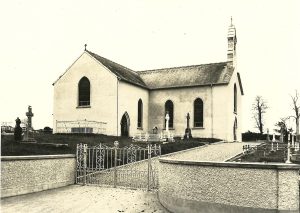
This year is the bicentennial anniversary of the building of St. Bartholomew’s Church in Piltown and next year the same milestone falls upon St. Cronan’s Church in Clashmore so for National Heritage Week 2025 we decided to take a closer look at these two beautiful buildings and some of the ancient religious sites in the parish which came before them.
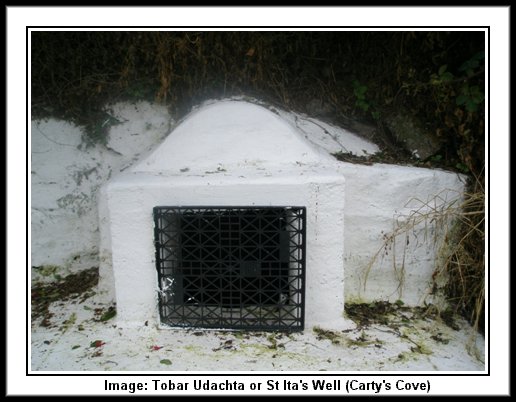
Some of the earliest church sites that we know of which existed around the parish were Kilmeedy (named for St. Ita), Kilgabriel, Kilmore, Kilmaloo (named for St. Molua) & Knockanaris (named for St. Columbderg), all of which are now untraceable on the ground (though some of the later ruined medieval sites were mapped on the earliest Ordnance Survey map in 1841). There are also several Holy Wells in the area, at least five in number – St. Mochua’s in Clashmore, St. Bartholomew’s in Piltown, St. Brigid’s at Ardsallagh, St. Columdearg’s at Knockaneris (which is now non-extant), and another known as Tobar Uachtha (the “Well of Penance”) on the townland of Monatray which is also reputedly named for St. Ita.
According to St. Ita, The Forgotten Princess by James Dunphy, Ita had travelled to Clashmore at the age of 20 around the year 495 A.D. where she spent at least five years and later established a church at Kilmeedy in a place now remembered as Páirc na Cille. Dunphy also goes on to describe a local holy well named in her remembrance called Tobar Uachta (or the Well of Penance according to Canon Power) at a place called An Gaibhlín in the townland of Monatrea East. He wrote that Ita and St. Declan of Ardmore would meet at this place to preach to large crowds of people, Declan having travelled by boat from Ardmore and Ita on horseback from Clashmore. She would often be flanked by guardsmen as she was a fugitive of sorts during her time here after her exploits in combat such as at the Battle of Lackamore at Cross, Clashmore which she only survived by the grace of God. Ita was held in very high devotion in this part of West Waterford and other areas of Waterford, along with several other places such as Gortroe in East Cork and as far away as Limerick where she had also left her mark.
Clashmore Origins
Saint Mochua, otherwise Cronan, is the patron of Clashmore and his feast day was kept locally on the 10th of February by visits to and prayers at a Holy Well dedicated to him known as Tobar Mochua situated near Clashmore village. St. Mochua, who was a disciple of St. Carthage of Lismore, founded an abbey here in the 7th century, wherein the saint and his household were reputedly murdered by a band of vikings marauding up the Blackwater about 631.The site later became the property of Sir Walter Raleigh at the dissolution of the monasteries in 1602. The present structure was built as a Church of Ireland in 1818 with the last minister being Rev. Carroll who lived at the Glebe House and retired in 1902 after which the congregation numbers dropped off and in 1927 the roof was taken off the building to avoid paying tax and was reused on the church at Ardmore. Locally a poem about St. Mochua is remembered and until recently was taught in the schools:
The Little Pets of St. Mochua
When Saint Mochua knelt to pray
Each morning at the break of day
There always was about the house
A rooster, fly and little mouse,
Three willing slaves to serve him well
And share his solitary cell.
The rooster every morning would crow
And waken him for matins, though
When he slept too sound to hear
The mouse came forth and nipped his ear,
And though he never had a clock
The mouse would call him, or the cock
And if he had to leave a book
From out some dusty hidden nook,
A fly with patience and with grace
Would sit for hours and mark the place.
It would be remiss of us to not also mention that ancient site of Kilmore which Canon Power wrote about extensively. He stated that:
“Kilmore was a remarkable ecclesiastical antiquity, which has remained hitherto practically unnoticed, standing on the north boundary of Kilmore townland. This is a great earthwork – the largest and best preserved monument of its kind in the Decies – enclosing a roughly quadrangular, or rather, kidney-shaped, area four or five acres in extent. On its outer edge, an embankment, twenty feet high by twenty feet thick, is surrounded by an excavated trench or moat several feet deep in sections and waterfilled towards its eastern end. Embankment and fosse, the former considerably worn down and the latter considerably silted up, are both in a wonderful state of preservation. Its name and local veneration show that this earthwork is of Christian association. On the other hand, strength of the defences and the surrounding fosse suggests a secular fortress; to this theory again, the site, a low-lying flat seems opposed. Probably the enclosure was originally a chieftain’s Dún (or Fort), surrendered later to the Church. Or, it may be, the strong defences were considered necessary even for a religious establishment in such a locality especially exposed to Scandinavian attack. We have already seen how the Danes paid, at least, one, disastrous visit to Clashmore. One is driven to surmise that Kilmore, rather than the adjoining Clashmore, may in fact be the site of the ancient sanctuary which the Northmen ravaged in 631”.
Kinsalebeg Origins
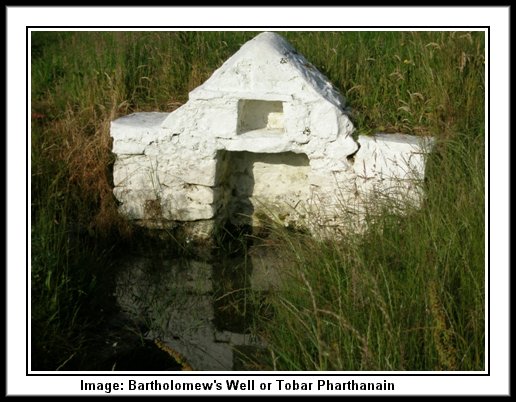
The Apostle, St. Bartholomew, is traditionally known as the patron saint of the parish of Kinsalebeg, and his feast day is kept on the 24th of August, by visits to the “Blessed Well” dedicated to him called Tobar Phárthanáin. On the Sunday nearest to his feast day, a public “pattern” was held at the well and at the adjoining village of Piltown, but later in time it was reported that this had to be stopped because of all the quarrelling & other distractions that came with it.
Looking closer at the original pre-reformation church of Kinsalebeg near Ferrypoint in Kinsalebeg Co. Waterford, it appears to have been in existence since at least 1291 AD, so at least over seven hundred years that can be traced. This in turn was replaced by a Board of First Fruits Church of Ireland church which was built in 1821. The last service there apparently took place in 1926, again after which the roof was removed and the building remains the same today. The attached burial ground was still used up until quite recently for Catholic burials and was since surveyed as part of the Historic Graves project (along with the old graveyard in Clashmore & St. Cronan’s burial ground)
Fast forwarding to shortly after Cromwell’s time, some Capuchins, who for a while had a quasi-residence at Hackettstown in the neighbouring parish of Ring, ministered in and around Piltown. A commissary of the Order, Father Bernardine, who made a visitation in 1656, describes his arrival at Piltown (at the residence of Thomas Walsh, Esq). He found Father Gregory Conroy, a Capuchin,
“living in a cave so narrow and small that one could not stand erect within it. It was early in the day and the poor friar, already exhausted after his morning’s labour, was stretched on his couch. The people, whose devotion is wonderful, flock to him in crowds for the sacraments. He never remains more than two days in the same place but travels around a district twenty miles in circumference”.
Penal Times
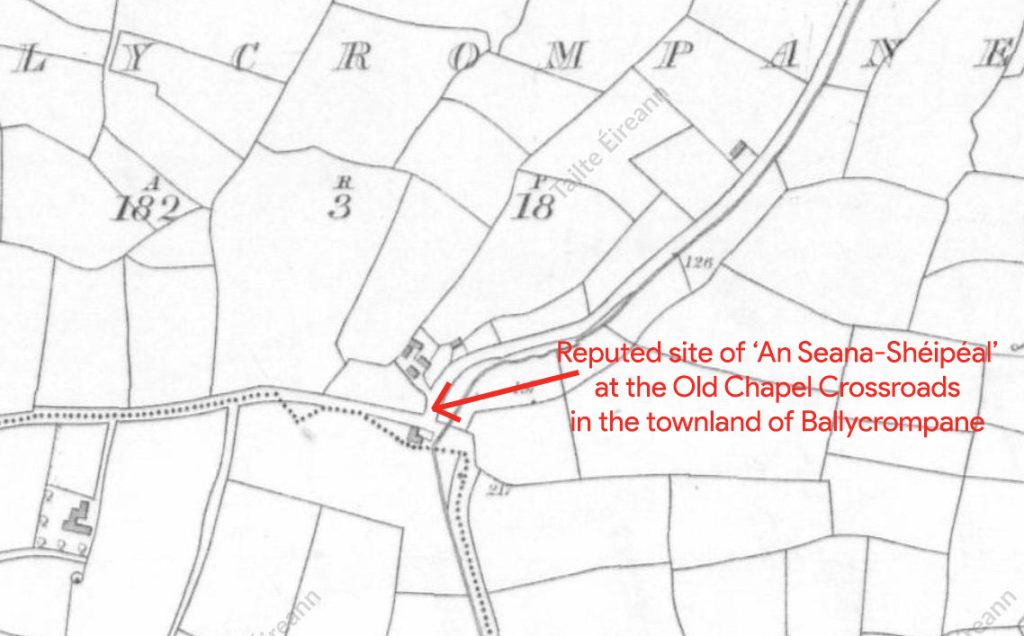
After this period a penal-times church known later as ‘An Seana-Shéipéal’ (The Old Chapel) existed at Hartery’s Cross (or Old Chapel Crossroads) in Ballycrompane and according to Canon Power it seems to have served the needs of both sides of the parish, although considering the difficult times it can only be presumed that practicing your faith in that period had to be done in a clandestine way. A now unused ‘mass path’ known as ‘Chapel Hill’ led up to this site but was later superseded by the present ‘Buaile Hill’ road.
Around that same period, at the date of the Registration of Parish Priests in 1704, Clashmore parish was united to Aglish and Whitechurch with Rev. Terence Sheehy as Parish Priest and Kinsalebeg was joined to Ardmore and Grange with Rev. Richard Power as Parish Priest. This arrangement was no doubt provisional to tide over the difficulties of the times.
Fast forwarding to the middle of the 18th century and after Fr. Sheehy’s time, Rev. William Brown became Parish Priest in and around 1769 of what appears to have been a joint Clashmore & Kinsalebeg Parish at that point. He was an uncle to the future Dean Hearn of Waterford, and gave to the latter and his distinguished brother Francis their first lessons in Latin. An old chalice still in use in the parish was commissioned by Father Brown, with his name inscribed and dated 1769. Father Brown was succeeded in the pastorate by his nephew, Rev. William Flynn, brother of Rev. Thomas Flynn P.P. of St . Michael’s, Waterford. Rev. Edmond Prendergast became Parish Priest in 1810 and was most probably appointed only that year. Written parochial records began during his tenure and we are lucky to have online access to these in recent years.
Church Establishment & Catholic Emancipation 1829
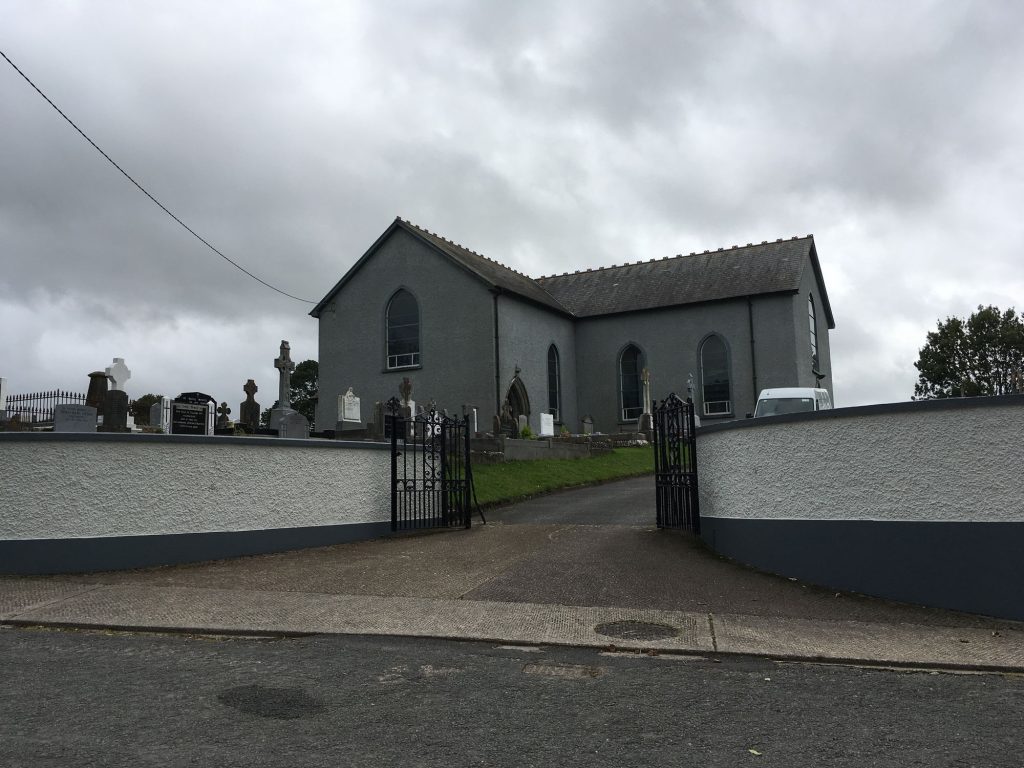
Prendergast was succeeded five years later by Rev. Michael O’Donnell who was a nephew of Bishop James O’Donnell of St. John’s Newfoundland. Fr. O’Donnell was responsible for building both of the present churches in the years 1825-26 and died in 1832. He is buried adjacent to the side door of the parish church. The church in Clashmore is now known as St. Cronan’s Parish Church but at least as late as 1890 it was still referred to St. Mochua’s Church (from an architectural reference of that year when renovations were carried out).
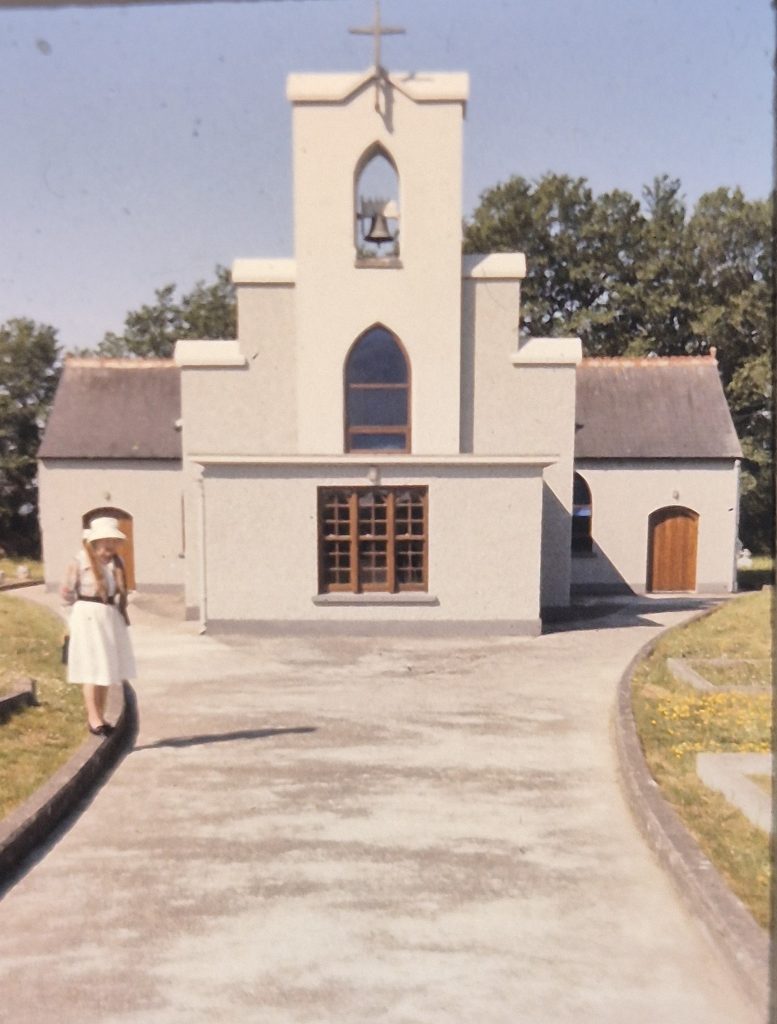
Rev. Patrick Quirk, translated from Tooraneena, succeeded Fr. O’Donnell and held office for twelve years to be succeeded in turn by Rev. Michael Purcell who transferred from Ring. Rev. Garrett Long became Parish Priest on death of Father Purcell in 1852 and was translated to Aglish in 1877, his brother Rev. Jeremiah Long being promoted in his stead to the pastorship of Clashmore. Rev. Jeremiah Long, was created Archdeacon of the Diocese in 1902 (essentially the Bishop’s right-hand man), and died at a great age in 1903. His time of service to this parish spanned over 45 years, during which time he renovated/rebuilt the church at Clashmore in 1891 and Fr. ‘Jerry’ was reportedly a very popular man with his parishioners for his generosity and his ardent support for national causes such as tenant’s rights & the Irish language.
His brother Fr. Garrett had previously been responsible for rebuilding Piltown Church in 1861. With the exception of some changes to the façade & belfry this church remained the same until it was fully rebuilt in the early 1990s to the beautiful building that we see today. Clashmore Church remains the same today with the exception of the removal of it’s bell and belfry in more recent times.
Here is a list of the Catholic Parish Priests & Curates that we know of who served in this parish over the centuries:
| Service Years | Parish Priest | Notes of Interest |
|---|---|---|
| 1356 | John de Balscote | |
| 1471 | John O’Boam | |
| 1493 | Maurice Ykarrayn (O’Corraoin?) | |
| 1503 | William Porcelle (Purcell?) | |
| 1545 | Thomas Bernard | |
| 1588 | Nicholas O’Cullen | |
| 1591 | Thomas Sherwin | |
| 1607 | Richard Donovan | |
| 1656 | Gregory Conroy | A saintly Capuchin who lived in a cave at Piltown |
| 1704 | Terence Sheehy, Clashmore & Richard Power, Kinsalebeg | |
| 1750 | Seán O Maoilríain | A Gaelic Poet |
| 1769-1795 | William Brown | First P.P. of Clashmore/Kinsalebeg |
| 1795-1810 | William Flynn | A nephew of William Brown |
| 1810-1815 | Edmond Prendergast | |
| 1815-1832 | Michael O’Donnell | He established both present churches |
| 1832-1844 | Patrick Quirk | |
| 1844-1852 | Michael Purcell | |
| 1852-1877 | Garrett Long | |
| 1877-1903 | Jeremiah Long | Created Archdeacon of the Diocese in 1902 |
| 1903-1918 | Thomas Power | |
| 1918-1919 | Patrick Doocey | |
| 1919-1927 | Thomas Mockler | |
| 1927-1945 | Patrick Murphy | |
| 1946-1952 | William Flynn | |
| 1952-1973 | David Power | |
| 1973-1980 | George McDonnell | |
| 1980-1990 | Joseph Murphy | |
| 1990-2017 | Maurice O’Gorman | |
| 2017-2020 | Fr. Conor Kelly | Became first Parish Administrator |
| 2019- | Fr. Milo Guiry | Current Parish Administrator |
| Service Years | Curate | Notes of Interest |
|---|---|---|
| 1858-1877 | Jeremiah Long | |
| 1890-1903 | Philip Power | |
| 1891-1896 | John Cantwell | |
| 1896-1897 | Maurice Cheasty | |
| 1897-1909 | Edmund Hassett | |
| 1909-1917 | Patrick Murphy | |
| 1917-1918 | William Ormond | |
| 1917-1919 | William Hickey | |
| 1919-1925 | William Flynn | |
| 1925-1938 | Peter Walsh | |
| 1927-1927 | John Lynch | |
| 1938-1945 | Michael Power | |
| 1945-1946 | Michael O’Doherty | |
| 1945-1952 | Denis Slattery | |
| 1952-1960 | Michael Power | |
| 1960-1964 | Michael Russell | |
| 1964-1968 | Edmond Tobin | |
| 1968-1974 | Michael Kennedy | |
| 1974-1994 | Billy Meehan | |
| 1994~2020 | Gerry O’Connor | Fr. Hubbard replaced him for some years in the late 1990s |
| 2017- | Fr. Conor Kelly & Fr. Philip Amooti Balikuddembe |
References
Waterford and Lismore: A Compendious History of the United Dioceses; Canon Patrick Power [1937]
The Faith Journey of the Déise People; Monsignor Michael Olden [2018]
St. Ita, The Forgotten Princess; James Dunphy [2006]